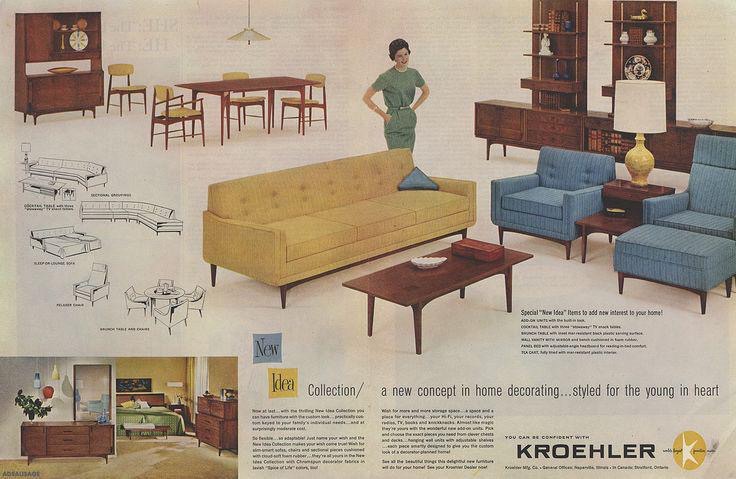
The living room occupies a central position in a post-war suburban home as it is the site of socialisation and the outward performance of marriage. The space reinforces the expectation that domestic harmony should be both lived and seen. Just like the living room, marriage was imagined as the stabilising centre of domestic life.
In John Cheever’s The Swimmer, (Cheever, 1964) Neddy Merrill rarely enters the private interiors associated with domestic intimacy. Marital life is implied through its absence. Neddy speaks of his wife and daughters as if they remain within the idealised script of suburban family life, yet his encounters suggest that this performance has already collapsed. Conversations with former friends expose the financial failure and marital breakdown in his life, “We’ve been terribly sorry to hear about your misfortunes, Neddy.” (Cheever, 1964) The italicised “terribly” (Cheever, 1964) implies condescension and the performance of pity fitting the assumption that suburban life provides comfort in its sociability when in reality it is a façade. This reveals that marriage in Cheever’s suburb can only be sustained while it can be convincingly performed in public. The illusion of domestic stability unravels not within the home but through social exposure.
Marriage in The Stepford Wives (Forbes, 1975) is turned into a spectacle of control, most visibly staged within the living room or in the confines of their home. Joanna’s marriage to Walter is framed by negotiation where he always succeeds, it was never Joanna’s choice to move to Stepford and she also has no say in Walter joining the Men’s Association. The living room repeatedly hosts conversations where Joanna’s dissent is reframed as emotional instability and her desire for autonomy pathologised. The living room functions as a disciplinary stage rather than a refuge, where Joanna is interrupted or dismissed. The men’s authority over marriage is literalised through technological intervention, transforming wives into performers who can no longer disrupt the script of suburban domesticity.
Within this walking tour, the living room functions less as a physical location but more as the space in which marriage is evaluated and enforced. Both texts reveal that in suburbia, marriage is not just private but also a public performance.
 A gendered walking tour of post-war suburbia