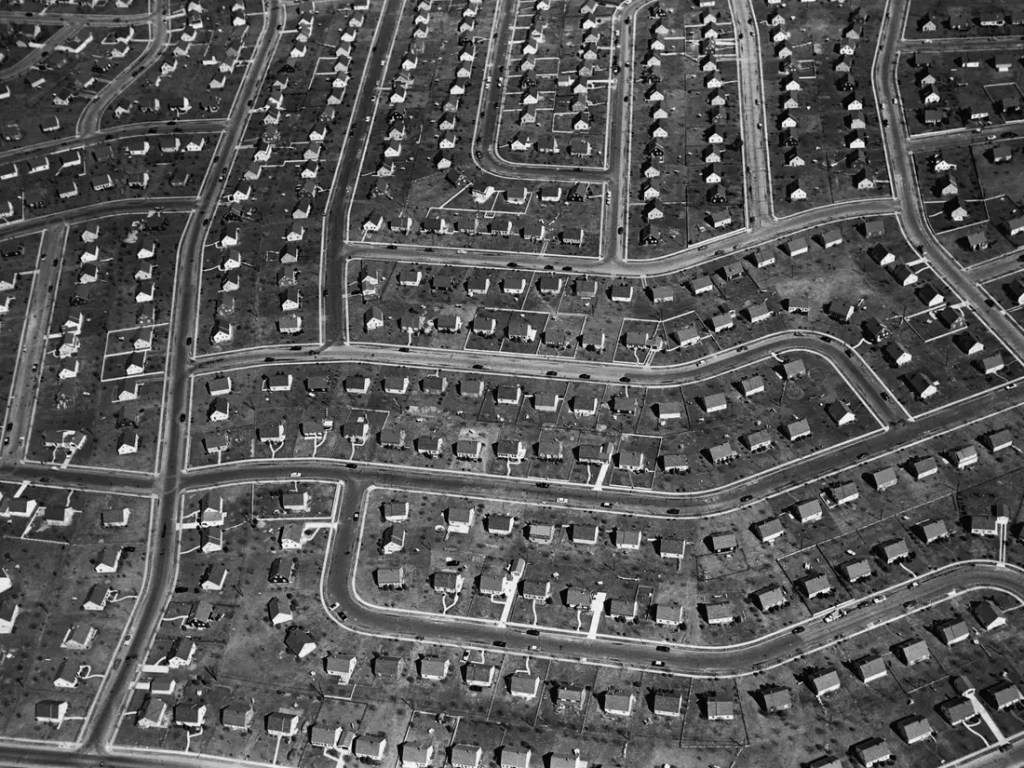
The front lawn is the first space encountered in this walking tour and it establishes suburbia not as a private retreat but as a public stage. In post-war suburbia, the front lawn is a display, the first impression of their homes and a visible marker of conformity. Mass suburban developments were enabled by the GI Bill and post-war economic expansion such as Levittown. This is corroborated in John Arthur’s article The Resilience of Myth: The Politics of the American Dream, “In the mid-1940s, with the end of World War II in view, marketers of building products and appliances seized this dream-house ideal as a fertile opportunity for commercial expansion.” (Archer, 2014) This continued on post-war because of the economic boom. The suburbs promised uniform comfort. The Levittown suburb photograph captures this logic of display and how belonging is measured through appearance. (Hulton Archive, c.1950s)
In The Stepford Wives, (Forbes, 1975) the front lawn operates as a literal site of performance. The lighting of Stepford’s neighbourhoods are bright, and this shows the lack of privacy. Women’s bodies are displayed on the lawns doing gardening chores or in Carol Van Sant’s case, as a sexual object for her husband. The women shown on the lawns are dressed in traditional seventies housewife clothing, in long modest dresses. Joanna stands apart from this and is visibly ill at ease in these settings. Her outfits are more modern 70’s as she wears jeans and crop tops, and she stands out against the backdrop of conformity. The visibility of the lawns is disciplinary and requires self-regulation to belong.
Contrastingly, in John Cheever’s The Swimmer, (Cheever, 1964) the protagonist is rarely placed on front lawns, however he is still governed by the same logic of performance. Neddy Merrill’s journey unfolds through backyards and their pools, spaces that feel private but remain socially exposed in the suburb as these are places of gathering and socialisation. His sense of self depends on being seen as the stereotypical, masculine figure of the sixties. Early in the narrative, hospitality sustains his confidence therefore allowing appearance to substitute for reality. Cheever’s narration initially supports this however later on Neddy’s delusions are revealed to the reader when he reaches the front of his house.
Cheever’s 1964 story shows post-war suburbia at its most complacent, when performance could still masquerade as authenticity. However, The Stepford Wives (Forbes, 1975) emerged after second wave feminism and exposes the ways in which women have to contort themselves in order to maintain the façade. As the first stop in this walking tour, the front lawn establishes suburbia’s central demand that before one can move freely within it one must first learn how to appear.
 A gendered walking tour of post-war suburbia