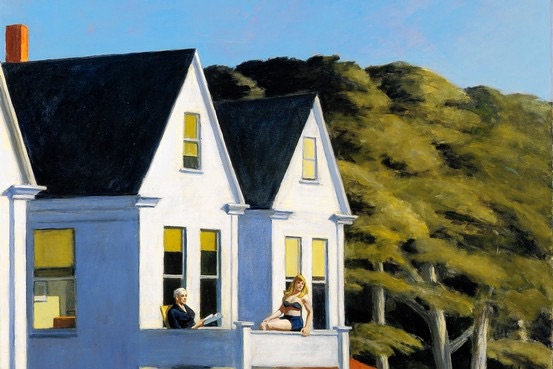
The edge of the suburb marks the point where the promises that structure post-war American life begin to unravel. Suburbia was built on the ideals of prosperity and comfort however the boundaries reveal that those promises are conditional. Edward Hopper’s Second Story Sunlight (Hopper, 1960) captures this tension. Although the scene is bright, the figures appear isolated and disconnected from the wider social world. This is shown through the boundaries of the balcony and the fact that they are on the second story.
In John Cheever’s The Swimmer, (Cheever, 1964) the edge of the suburb is reached not geographically but psychologically. Neddy Merrill’s journey ends at his home where his delusions collapse. The house is empty, finally revealing his financial ruin and marital breakdown. The suburban ideal that once appeared limitless is exposed as finite. Cheever’s story reframes the American Dream as a fragile performance, once Neddy can no longer sustain the illusion of success suburbia becomes inaccessible to him.
The Stepford Wives (Forbes, 1975) presents a more sinister boundary. Attempts to leave Stepford by Joanna are repeatedly rendered impossible. The suburb functions as a closed system designed to contain women rather than support them. When entering Stepford for the first time, a graveyard is seen at the edge of the suburb, foreshadowing Joanna’s ending. The edge of the suburb becomes a site of threat where autonomy dissolves. Joanna’s final failure to escape shows that the American Dream is preserved through control.
Placed as the final stop of this walking tour, the edge of the suburb exposes the ultimate cost of post-war suburban ideology. The suburbs initially promised comfort and freedom for both Neddy and Joanna but ultimately ended in isolation and loss. At its limits, suburbia no longer sustains identity, it erases it.
This walking tour has traced post-war suburbia as a performance rather than a site of genuine freedom. The Swimmer (Cheever, 1964) and The Stepford Wives (Forbes, 1975) reveal how freedom is sustained through appearance. By moving through the suburban space step by step, the tour shows that the American Dream is not simply lost at suburbia’s edge but is eroded from within.
 A gendered walking tour of post-war suburbia