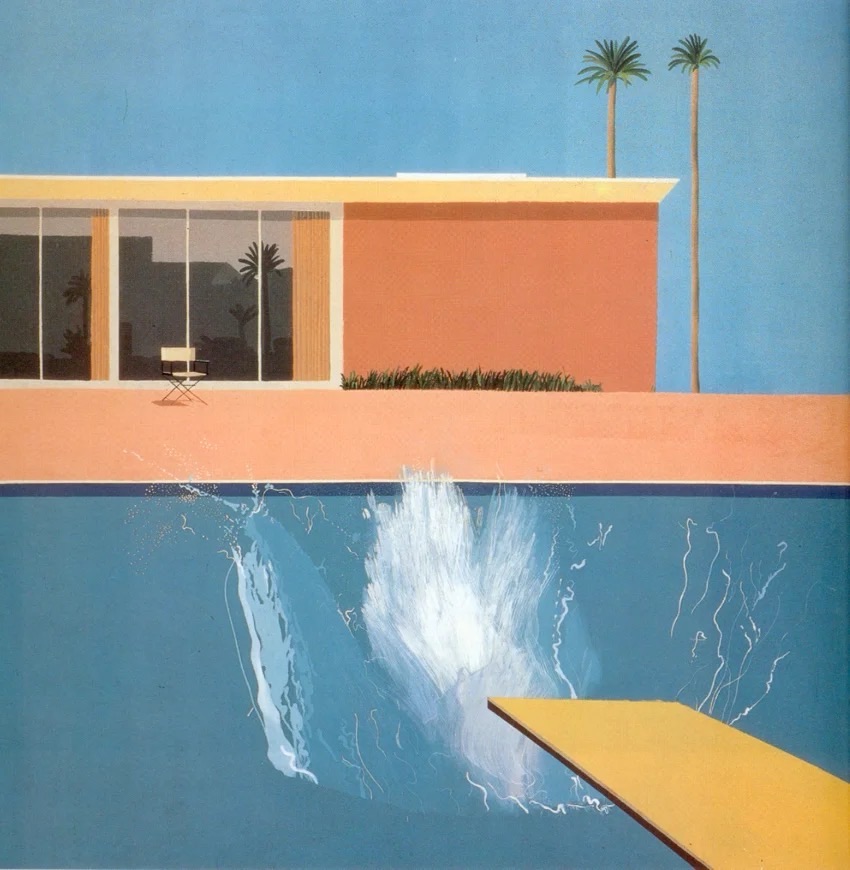
In post-war American suburbia, the swimming pool is often a symbol of mobility where mobility itself is a symbolic measure of autonomy. Movement is never a neutral action as it reveals the power structures underlying in suburban life. In The Stepford Wives (Forbes, 1975) and The Swimmer, (Cheever, 1964) the character’s relationships to movement shows the unequal distribution of freedom.
In The Swimmer, (Cheever, 1964) Neddy Merrill’s self-imposed journey through the swimming pools of suburban Westchester County, New York, is an imagined form of mastery. By renaming the chain of private spaces to “Lucinda River” (Cheever, 1964), he constructs a fantasy of uninterrupted passage through the suburb. Rick Moody shows how Neddy’s constant movement is a distraction from his moral failings, “these ambitions were especially vivid in the conjunction of Cheever’s moral vision and the persistent inability of his characters to measure up to this vision.” (Moody, 1997) His belief in his masculinity is only a fantasy and albeit a fragile one, as the journey becomes an act of denial, a way to preserve his masculinity and to shield himself from his reality of aging, loss, and social failing.
Similarly, The Stepford Wives (Forbes, 1975) initially portrays mobility as natural. One advantage of moving to the suburb is repeated throughout the film, the idea that Joanna can move freely throughout the suburb with no concern for her safety. This is a false ideal as Joanna’s and other women’s autonomy to move is stripped from them such as Walter preventing Joanna from leaving the house towards the end of the film. Possibly the most prevalent example of a women’s right to the freedom of mobility being taken from her is when Charmaine’s tennis court is destroyed and turned into a swimming pool by her husband. Charmaine’s tennis court was one of the few spaces that genuinely enabled female mobility and allowed a form of physical agency that was not domestic. Its destruction and replacement with a swimming pool marks a crucial shift of movement being neutralised.
Together, these texts reveals that post-war suburbia manages mobility unevenly, allowing men to exhaust the illusion of freedom while systematically removing it from women. Positioned at the swimming pool, this stop exposes how spaces that promise the ability to move freely within them instead regulate who may move within them.
 A gendered walking tour of post-war suburbia