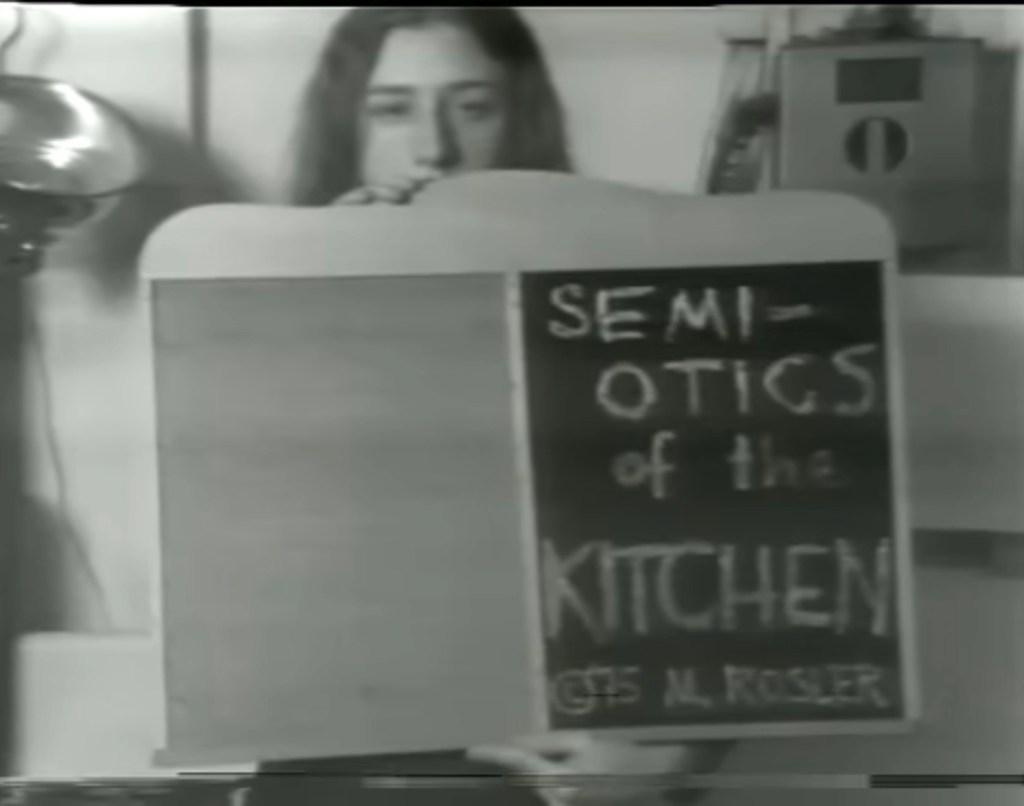
Click here to watch.
If the front lawn is a performance of suburban harmony, the kitchen is the domestic labour required to keep the illusion of perfection going. In post-war American culture, the kitchen was idealised as a site for the fulfilment of women. This illusion was constructed by Cold War consumerism, the rise of suburban housing developments and the ideology of the nuclear family. Yet both The Swimmer (Cheever, 1964) and The Stepford Wives (Forbes, 1975) expose the kitchen as a space of gendered confinement, a space that fixes women in place while enabling masculine mobility elsewhere.
In The Swimmer, (Cheever, 1964) the importance of the kitchen is not based on its visibility but on its absence. Cheever’s narrative follows Neddy Merrill as he accepts food, drink and hospitality along his journey while never encountering the labour that produces them. Domestic work exists only behind the scenes, displaced onto unnamed women or caterers that are not at the forefront of the narrative. Nina Baym writes that “… the matter of American experience is inherently male.” This explains why Neddy can ignore the behind-the-scenes workings of the suburb. This narrative is structurally significant as Cheever’s limited focalisation aligns the reader with Neddy’s perspective exposing the post-war masculine assumption that comfort is a natural feature of suburban life rather than the result of feminised labour. The kitchen is rendered invisible in order to preserve the illusion of masculine autonomy.
Contrastingly, in The Stepford Wives (Forbes, 1975) the kitchen’s visibility is insisted on because of the context of second wave feminism and the backlash it provoked. The women who had been replaced with mechanised beings are repeatedly shown in the kitchen. This is validated in Jane Elliott’s article, Stepford U.S.A Second-Wave Feminism, Domestic Labor, and the Representation of National Time, “The Stepford Wives highlights the specularity of hyperfemininity as a mode of domination, particularly in its filmic version, both the novel and the film consistently associate the domination of women’s time with housework.” (Elliott, 2008) Joanna’s refusal to submit to these routines and instead focus on her career as a photographer, marks her as disruptive. The kitchen is not merely a domestic space but a site of ideological enforcement. This fixation reflects the anxieties of the 1970s as women’s increasing participation in the workplace was often countered by cultural narratives.
Martha Rosler’s Semiotics of the Kitchen (Rosler, 1975) was produced in the same cultural moment as The Stepford Wives and offers a visual parallel. Rosler’s performance transforms domestic utensils into symbols of the violence embedded in the expectation of feminised labour. Unlike Cheever’s erasure of the kitchen, Rosler and The Stepford Wives, (Forbes, 1975) foreground it as a space of discipline and containment.
 A gendered walking tour of post-war suburbia